War cannot end war
The Constant PrincessWar cannot end war is the principle Katherine of Aragon arrives at only after learning to question the crusading convictions that once defined her sense of duty. The idea is not an abstract renunciation of conflict: it emerges from a queen’s decision, made in the aftermath of victory, not to devastate a defeated neighbor. By choosing surrender and an offer of peace over vengeance, Katherine turns a military success into an argument that the cycle of retaliation must be broken.
From crusade to doubt
As a young woman, Katherine understands her marriage to Arthur, Prince of Wales, as part of God’s work. She regards a durable alliance between England and Spain, her homeland, as essential to resisting France and defending Christendom. English wealth and ships, she believes, could help Spain carry war against Muslim powers into Africa and the Ottoman Empire, and onward toward India and the East. In this early vision, religious duty and dynastic alliance reinforce each other: military expansion appears to be a necessary defense against a threat without an end.
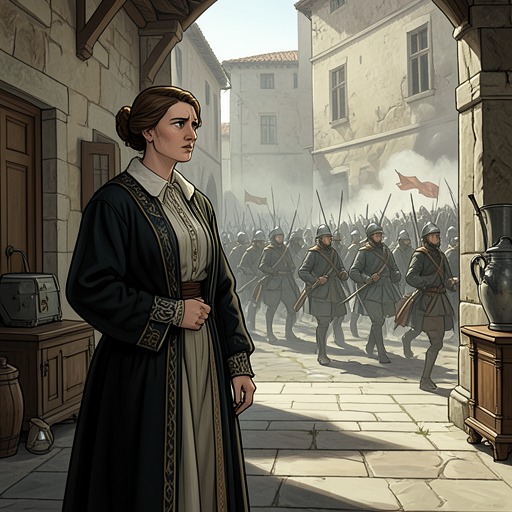
That sense of boundless struggle is already troubled by what Katherine witnesses at Granada. As people are sent away, she sees women weeping and men with bowed heads; the Christian flag flies over the red fortress where the crescent had flown, and church bells sound where Muslim prayers had once been heard. She wonders whether defeating one group can end the conflict if those driven away may return. The question exposes the weakness inside the crusading promise: victory can displace an enemy without removing the conditions for another war.
Her earlier certainty is not erased so much as brought into conflict with experience. The imagined campaign against distant powers and the immediate suffering of defeated people belong, for Katherine, to the same history of religious war. What changes is her judgment of what victory can accomplish. A conquest may be presented as a defense of faith, yet its consequences can carry hostility forward rather than resolve it.
The choice after victory
The principle becomes decisive after the defeat of Scotland. When Katherine is asked whether the army should advance and lay the country waste, she initially gives the answer expected of a victorious monarch. Scotland’s weakness seems to offer an opportunity to crush a familiar enemy. But she pauses and reconsiders, setting aside the reflex to treat military advantage as permission for further destruction.
Katherine’s internal reckoning makes the change explicit. She tries to think as a soldier and a queen rather than as a pregnant woman imagining the widows left behind. Her parents, Isabella of Castile and Ferdinand II of Aragon, would have acted without hesitation, she thinks; she has spent her life learning to admit that they were wrong. Their military genius and Christian reputation do not make their choices a reliable guide. The admission is especially significant because the certainty she rejects once seemed inseparable from the faith and royal duty she inherited from them.
She reasons that a state of constant warfare wounds victor and defeated alike. The defeated may recover; their children may return against the victor’s children, renewing the same battle. In Katherine’s image, a devastated country grows not security but rats and pestilence. Her warning is not that victory is unreal: the army has won. It is that victory cannot, by itself, extinguish the conditions that produce the next conflict. As she concludes, “War does not answer war, war does not finish war. The only ending is peace.”
Peace as an act of rule
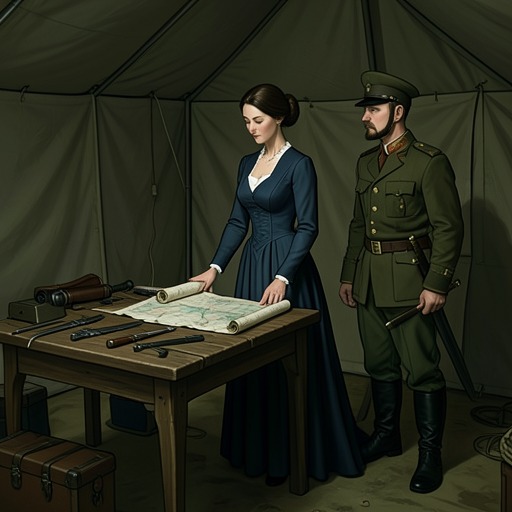
Katherine gives the principle practical form through orders sent from her camp. A fresh messenger is to thank Lord Surrey for the great victory, but also to tell him that the Scottish soldiers should be allowed to surrender their arms and go in peace. Katherine will write to the Scottish queen and promise peace if she will be a good sister and neighbor. The language of kinship does political work: it offers a relation other than permanent enmity, even while acknowledging that peace depends on a reciprocal response.
The decision changes the meaning of the victory. Katherine tells the waiting soldier that the army can return home believing it can live at peace; her stated purpose is to make the triumph lasting rather than turn it into an excuse for savagery. The choice does not undo the battle or make the two kingdoms’ hostility disappear. Instead, it declines to enlarge the defeat into another generation’s grievance. Peace is presented as a deliberate political outcome that must be chosen at the moment when vengeance is most available.
Even the material signs of victory are redirected. Katherine writes to Henry VIII and sends him the dead Scottish king’s coat, emphasizing that the victory belongs to him. Yet in her private reflection at Walsingham, she says the victory is Arthur’s in a deeper sense: it was Arthur who had taught her to see the Scots as the danger in her new country. Her act of restraint, then, grows from a changed understanding of the conflict Arthur helped her recognize, rather than from forgetting the loyalties that shaped her earlier life.
Memory, forgiveness, and the limit of victory
At Walsingham, Katherine connects her offer of peace to a further reversal in her judgment. Life, she reflects, taught her that forgiving an enemy is better than destroying one. She imagines that the country might have been stronger had it possessed Moorish physicians, astronomers, and mathematicians. The thought challenges the earlier idea that the people marked as enemies could only be threats to Christendom: they might also possess knowledge that the victors lack. She likewise hopes that the Scots may one day offer skills and courage the country needs, and that her offer will help them forgive the violence of the Battle of Flodden.
The reflection does not make Katherine indifferent to danger or deny the costs of war. She believes that the victory will protect the kingdom for a generation, and she sees the peace offer as one way to preserve that security. But she refuses to confuse safety with the destruction of an enemy. The principle remains an argument about consequences: if war breeds hatred, then a victor who chooses further devastation helps prepare the next conflict.
Her private grief sets a limit on triumph as well. Katherine has the crown, the people’s love, the prospect of a child, and hope that Henry will be a good husband and man; still, she says that she has everything she wanted except Arthur. She hopes to name a son Arthur or a daughter Mary, carrying the memory of her first husband into the imagined future. Her final return to the absent beloved places the political lesson beside personal loss: victory can secure a kingdom and peace can spare future lives, but neither can restore the dead. In that tension, War cannot end war becomes not a claim that conflict is easily overcome, but a hard-earned refusal to let victory dictate another act of vengeance.